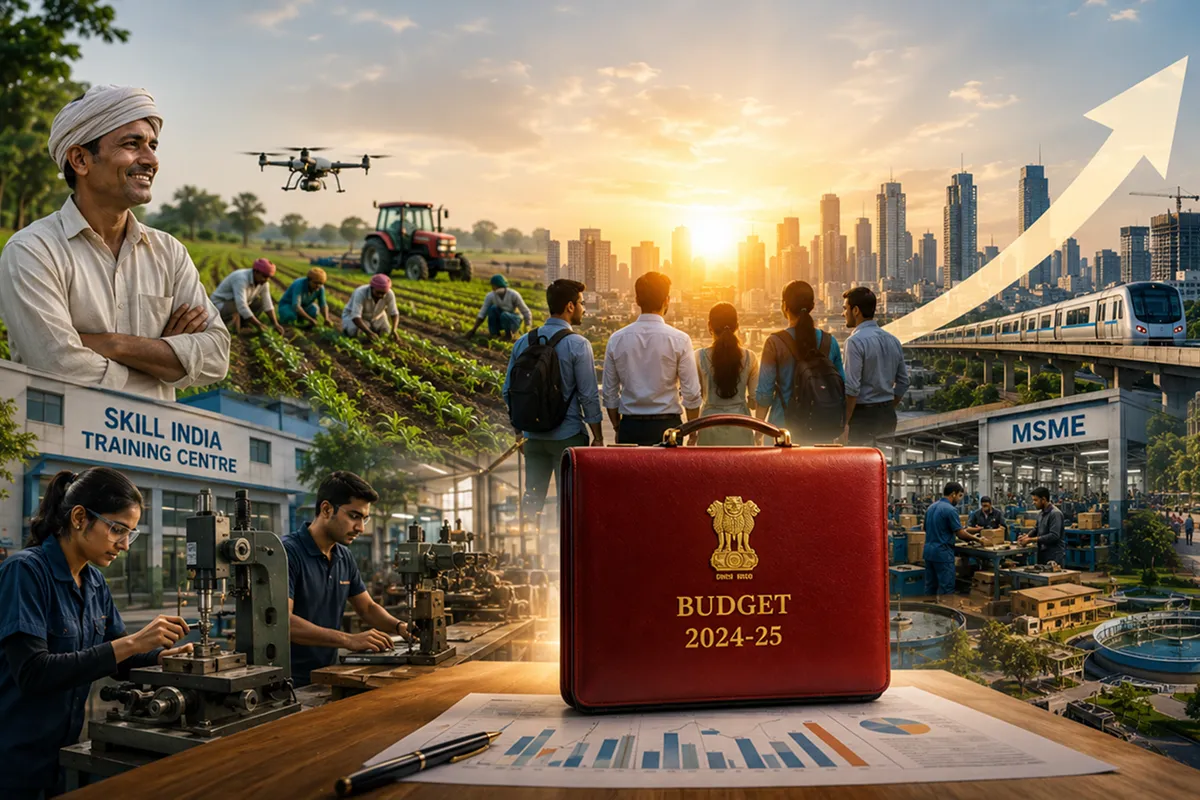
The Union Budget 2024-25, presented by Finance Minister Nirmala Sitharaman, outlines a clear vision for transforming India into a developed nation. With a strong emphasis on employment, skilling, MSMEs, and the middle class, the budget aims to create a robust economy, generate ample opportunities, and improve the overall quality of life for its citizens.
The Four Pillars of the Budget
The budget is centered around four key pillars:
1. Employment and Skilling
The government has recognized the critical importance of employment generation and has introduced a comprehensive package of initiatives to address this challenge. The centerpiece of this package is the Prime Minister’s Employment Linked Incentive (ELI) scheme, which includes a few sub-schemes:
- First Timers Scheme: Offers a one-month wage subsidy to new entrants in formal sectors.
- Job Creation in Manufacturing Scheme: Provides incentives to both employers and employees for EPFO contributions in the manufacturing sector.
- Support to Employers Scheme: The government will reimburse EPFO contributions for employers for new hires.
- Skilling Programme: 20 lakh youth will be skilled over 5 years. Also,1000 industrial training institutes will be upgraded in the hub and spoke arrangements with outcome orientation. The overall course content and design aligned with the skill needs of the industry.
In addition to these schemes, the budget also focuses on skilling and upskilling the youth through initiatives like upgrading Industrial Training Institutes (ITIs) and providing internship opportunities in top companies.
2. Agriculture and Rural Development
Agriculture research transformation focuses on increasing productivity and developing climate-resilient crop varieties. Efforts are being made to promote vegetable production and supply chains through farmer-producer organizations (FPOs), cooperatives, and startups, enhancing collection, storage, and marketing capabilities. A notable release includes 109 new high-yielding, climate-resilient varieties of 32 field and horticulture crops. In pursuit of Atmanirbharata, there is a push for oilseed cultivation, including mustard, groundnut, sesame, soybean, and sunflower.
Strengthening the Agricultural Ecosystem
Natural Farming
The Indian government’s ambitious plan to introduce one crore (10 million) farmers to natural farming over the next two years marks a significant shift towards sustainable and eco-friendly agricultural practices.
There are a few Components of the Initiative:
- Farmer Training: A large-scale training program will be implemented to educate farmers about the principles and techniques of natural farming.
- Certification and Branding: To promote and recognize the efforts of farmers adopting natural farming, a certification process will be established. Additionally, branding initiatives will help differentiate natural farm produce in the market.
- Bio-Input Resource Centers: The establishment of 10,000 bio-input resource centers will provide farmers with easy access to essential inputs like compost, biofertilizers, and other organic materials required for natural farming.
Support for shrimp production and export:
Providing financial assistance through NABARD.The National Bank for Agriculture and Rural Development (NABARD) is a key player in supporting this sector. By providing financial assistance it will
- improve infrastructure for shrimp production, processing, and export.
- Facilitate access to credit for small and marginal shrimp farmers.
Digitalization of Agriculture
Digital technology is revolutionizing the agricultural sector, enabling efficient resource management, improved decision-making, and better market linkages for farmers.
- Digital Public Infrastructure (DPI): This initiative aims to create a robust digital platform that connects farmers, government agencies, and other stakeholders. Key components include:
- Digital Crop Survey: Collecting accurate and real-time data on crop patterns, acreage, and yields across 400 districts. This information is crucial for policymaking, resource allocation, and disaster management.
- Kisan Credit Cards: Providing farmers with easy access to credit through digital platforms, reducing paperwork and processing time.
These cards can be linked to various government schemes and subsidies.
3. MSMEs
The government has introduced several initiatives to support the manufacturing and services sectors, particularly focusing on MSMEs. A new Credit Guarantee Scheme is being launched for MSMEs in the manufacturing sector, accompanied by a new assessment model for MSME credit.
Key Focus Areas
- New Credit Guarantee Scheme: This scheme is specifically designed for MSMEs in the manufacturing sector, aiming to improve their access to credit.
- MSME Credit Assessment Model: A revamped assessment model will streamline the credit evaluation process for MSMEs.
- Increased Mudra Loan Limit: The ‘Tarun’ category of Mudra Loans has been doubled to ₹20 lakh, providing more financial flexibility to MSMEs.
- Credit Support during Stress Periods: This provision offers a lifeline to MSMEs during economic downturns.
- Expanded TReDS Onboarding: Making TReDS mandatory for more businesses will accelerate cash flow for small enterprises.
- Focus on Food Processing: MSMEs involved in food irradiation and quality testing will receive special attention to enhance food safety standards.
4. Urban Development
Urban Development Initiatives
The Indian government has outlined several key initiatives to improve urban living conditions. Let’s break them down:
1. Stamp Duty Reduction for Women
It aims To encourage women’s homeownership. By reducing the financial burden on women, this measure is expected to increase property ownership among women, it will contribute to women’s empowerment and economic independence.
2. Development of Street Markets
To revitalize public spaces and promote local businesses this initiative is taken it can boost local economies, create employment opportunities, and enhance the overall urban experience by creating vibrant public spaces.
3. Transit Oriented Development
To promote sustainable urban development and reduce traffic congestion among 14 large cities with populations above 30 lakhs cities this initiative is taken it will mainly focus on the
developing infrastructure around public transportation hubs.
4. Water Management
It mainly aims to improve the overall living conditions in urban areas, this initiative will promote water supply, sewage treatment, and solid waste management projects and services for 100 large cities through bankable projects.
What is PM Awas Yojana Urban 2.0?
The PM Awas Yojana Urban 2.0 aims to address the housing needs of one crore urban poor and middle-class families with a significant investment of ₹10 lakh crore. In addition to providing housing, the scheme will implement enabling policies and regulations to create efficient and transparent rental housing markets, thereby increasing the availability of rental properties.
Tax Proposals
The new tax proposals enhance economic efficiency, simplify trade, and foster sectoral growth. A detailed overhaul of customs duty structures aims to streamline processes, reduce disputes, and eliminate duty inversion
The main key changes are :
Exemptions:
- Three additional cancer medicines are fully exempt from customs duties.
- Capital goods used in manufacturing solar cells and panels are exempt from supporting the energy transition.
- Customs duties on 25 critical minerals are fully exempt to boost strategic sectors.
Reductions:
- Basic Customs Duty (BCD) on mobile phones, PCBAs, and chargers is reduced to 15%.
- Customs duty on gold and silver lowered to 6% and platinum to 6.4%
- BCD on shrimp and fish feed is reduced to 5%.
Rationalization of Capital Gains
The rationalization of capital gains tax is a step towards a more streamlined and efficient tax system
Short-Term Capital Gains:
- Financial Assets: A uniform tax rate of 20% will be applied to short-term capital gains on financial assets.
Long-Term Capital Gains:
- Financial and Non-Financial Assets: A standardized tax rate of 12.5% will be applied to long-term capital gains on both financial and non-financial assets.
Exemption Limit:
- Capital Gains on Financial Assets: The exemption limit for capital gains on financial assets will be increased to ₹1.25 lakh per year, providing additional relief to investors.
Investment and Employment Incentives
To encourage investment and job creation, the government has introduced several key measures:
- Abolition of Angel Tax:
- The Angel tax, which previously applied to certain investments in startups, will be abolished for all classes of investors. This move aims to foster a more supportive environment for startup funding and innovation.
- Simplified Tax Regime for Domestic Cruise Operations:
- A streamlined tax regime will be implemented to facilitate the operation of domestic cruise lines, promoting growth in the tourism and hospitality sectors.
- Safe Harbour Rates for Foreign Mining Companies:
- Foreign mining companies selling raw diamonds will benefit from safe harbor rates, providing them with a clear and predictable tax environment.
- Reduction in Corporate Tax Rate for Foreign Companies:
- The corporate tax rate for foreign companies operating in India will be reduced from 40% to 35%, making India a more attractive destination for foreign investment.
Simplifying the New Tax Regime
- Tax Savings:
- Individuals can save up to ₹17,500 under the new tax regime.
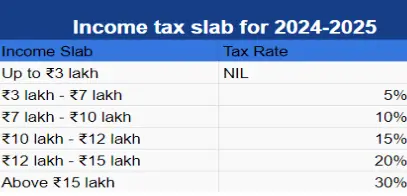
- Tax Slabs:
- Income up to ₹3 lakh: NIL
- Income from ₹3 lakh to ₹7 lakh: 5%
- Income from ₹7 lakh to ₹10 lakh: 10%
- Income from ₹10 lakh to ₹12 lakh: 15%
- Income from ₹12 lakh to ₹15 lakh: 20%
- Income above ₹15 lakh: 30%.
The Four Pillars of the Budget
Increased Deductions
- Standard Deduction:
- Increased from ₹50,000 to ₹75,000 for salaried employees.
- Family Pension Deduction:
- Increased from ₹15,000 to ₹25,000 for pensioners.
These measures are designed to support economic growth, enhance investor confidence, and provide relief to taxpayers.
Conclusion
The Union Budget 2024-25 is more than just numbers, it’s a blueprint for India’s journey toward becoming a developed nation. By addressing the core challenges like employment, skilling, agriculture, MSME, and urban development, the government proves that it aims to empower India into a new era of prosperity. Now it’s time to convert these ambitious plans into realities. With the help of public participation, India can truly become a global powerhouse.