The Chief Financial Officer’s (CFO) brief has profoundly expanded. Beyond managing ledgers, the CFO is now the Chief Risk Strategist, directly responsible for safeguarding the firm’s financial health against systemic threats. This leadership role is non-negotiable given the volatile environment expected in 2025: persistent market shifts, sophisticated cyber threats, the ethical challenge of artificial intelligence (AI) adoption, and rising environmental, social, and governance (ESG) scrutiny. This framework focuses on the financial, technology governance, and integrity risks that land squarely on the CFO’s desk, detailing the impact and concrete mitigation steps.
Risk Management: Core to Strategic Finance Leadership
Risk-aware decision-making is the foundation of smart finance. A robust framework informs every critical choice, from capital expenditure to treasury management, directly impacting profitability and securing investor trust. The CFO connects strategy to operational resilience. By prioritizing predictive risk intelligence, the finance function shifts from reactive cleanup to proactive defense, turning risk management into a source of strategic advantage.
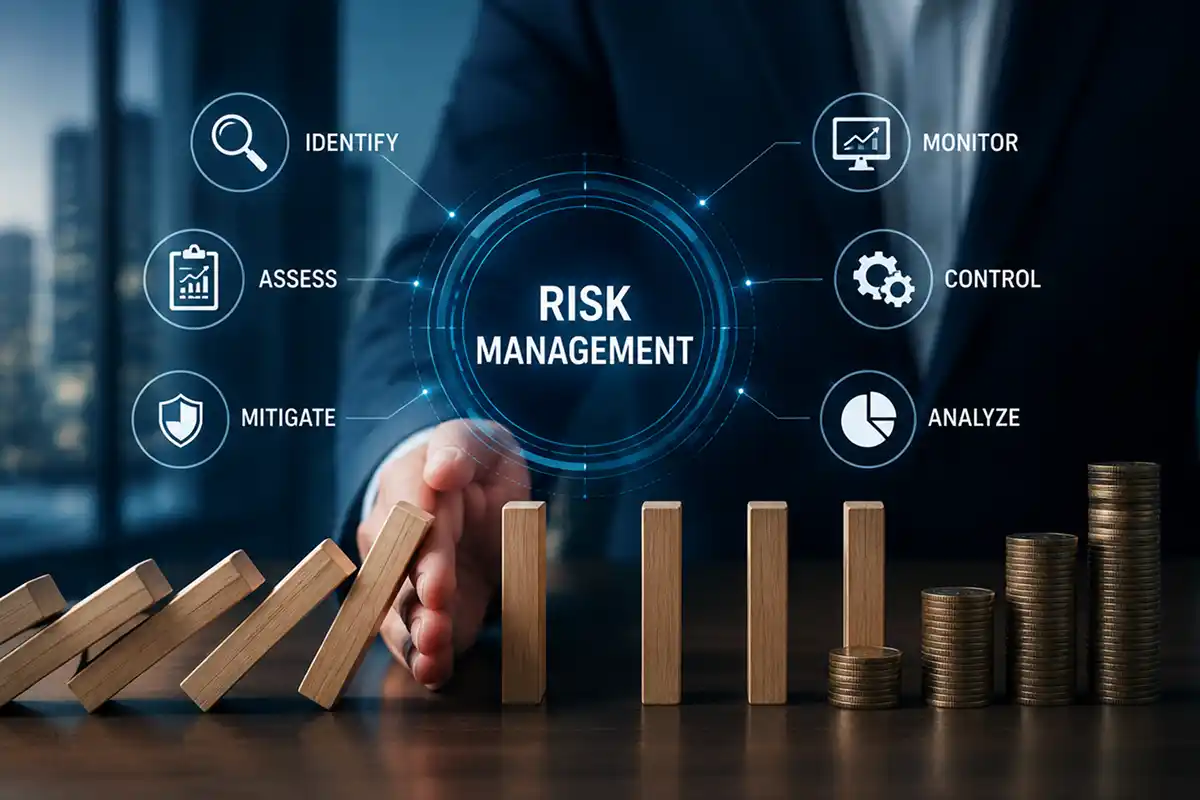
Pillars of a CFO-Led Risk Management Framework
A successful framework is built on rigorous processes that empower the finance team:
- Risk Identification: Map threats across financial stability, data integrity, and regulatory compliance.
- Risk Assessment: Use stress tests and scenario modeling to quantify the potential financial loss of each risk.
- Risk Mitigation: Define specific financial controls, hedging policies, and business continuity plans.
- Compliance Governance: Embed internal controls and audit procedures across all finance processes, paying special attention to emerging ESG reporting mandates.
- Monitoring & Reporting: Use custom dashboards and key performance indicators to provide real-time visibility to the leadership team and the Board.
Direct Financial Risk: Impact and Mitigation
The CFO’s primary duty is managing risks that directly erode financial value.
A. Interest Rate Risk
This is the risk that changes in market interest rates will negatively affect the company’s financial condition.
- Impact and Example: Rising rates increase the cost of variable-rate debt, reducing net income. For example, if a company has a large loan tied to a benchmark rate that rises by two percentage points, the resulting unexpected increase in interest expense directly reduces the profit margin.
- CFO Mitigation:
- Hedging: Use financial instruments, such as interest rate swaps or caps, to lock in predictable interest expenses on existing debt.
- Debt Structuring: Strategically balance the debt portfolio between fixed-rate and variable-rate loans to optimize cost and flexibility.
- Sensitivity Analysis: Regularly model the impact of large interest rate swings ($+2\%$ or $-2\%$) on the income statement and cash flow before external shocks occur.
B. Foreign Currency Risk
This is the risk that fluctuations in currency exchange rates will alter the value of international transactions, reported earnings, or overseas assets.
- Impact and Example: Adverse currency movements can lower reported revenue from international sales. For example, if an India-based company sells software services to a client in Germany and the Euro weakens against the Indian Rupee before the payment is received, the Rupee equivalent of that revenue is unexpectedly reduced, shrinking the profit margin on the sale.
- CFO Mitigation:
- Natural Hedging: Match revenue earned in a foreign currency with expenses paid in the same currency as much as possible.
- Financial Hedging: Use forward contracts or options to secure a fixed exchange rate for material future transactions, eliminating uncertainty.
- Invoice Strategy: Negotiate payment terms in the company’s home currency where commercially viable.
Integrity and Technology Risks: Guarding Financial Systems
The CFO is the ultimate guardian of the systems and processes that handle money and sensitive data.
A. Technology Risk (System Failure & Security)
This covers the threats that arise from the reliance on core financial and operational systems, including catastrophic outages and data breaches.
- Impact and Example: A major system outage in the core financial planning or payment processing software halts operations, leading to immediate lost revenue and potential customer penalties. For instance, if the primary business system goes down for a full day, all sales and invoicing stop, resulting in massive, quantifiable financial loss.
- CFO Mitigation:
- Cyber Budgeting: Treat strong cybersecurity as a continuous investment, ensuring dedicated funding for system hardening and specialized monitoring tools.
- Resilience Planning: Mandate frequent testing of system recovery plans (how quickly can we restore core financial and operational functions after a disruption?).
- Vendor Vetting: Establish a clear financial assessment of all technology suppliers, ensuring they meet rigorous data security and operational uptime standards.
B. Fraud Risk
This encompasses both internal fraud (e.g., employee embezzlement) and external fraud (e.g., sophisticated vendor invoice scams).
- Impact and Example: Direct financial loss is immediate. For example, in an external scam known as Business Email Compromise, a finance team member is tricked into wiring a large sum of money to a fraudulent bank account, leading to an immediate write-off and costly internal investigation.
- CFO Mitigation:
- Strong Controls: Enforce non-negotiable segregation of duties—no single person should control a transaction (from invoice approval to payment) from start to finish.
- Continuous Monitoring: Implement data analytics tools within the accounting system to spot unusual payment patterns or sudden changes to vendor bank details immediately.
- Ethical Program: Foster a culture where employees are comfortable reporting irregularities without fear of reprisal, promoting integrity across all financial dealings.
Integrating Technology and AI for Risk Intelligence
Technology is the CFO’s best defense. Leveraging predictive analytics and AI moves the finance function beyond historical reporting.
- Real-time Monitoring: Use AI to analyze transaction flows and flag potential fraud or control failures before funds are disbursed.
- Scenario Modeling: Technology can run thousands of complex simulations (e.g., simultaneous currency volatility and supplier bankruptcy) to instantly test the balance sheet’s ability to withstand shocks.
- Finance Transformation: CFOs must ensure that every large-scale technology initiative—from cloud migration to new enterprise system adoption—has integrated risk controls and monitoring baked into the design.
Linking Risk Framework to Strategic Decision-Making
The framework’s value is realized when it guides growth. The CFO’s role is to ensure that strategy is risk-adjusted:
- Capital Allocation: All new investments (mergers, acquisitions, research, and development) must be measured using a metric that factors in the cost of risk, ensuring the expected return justifies the inherent uncertainty.
- Risk Appetite: Clearly define and communicate the level of risk the company is willing to accept, and ensure this directly aligns with stated financial targets and investor expectations.
Conclusion: The CFO as a Guardian of Resilience
The CFO stands as the primary Guardian of Organizational Resilience. By strategically focusing on and mitigating core financial and integrity risks—from hedging against interest rate swings to fortifying systems against cyber intrusion—CFOs ensure that financial acumen is paired with strategic foresight. Their leadership is the critical difference between navigating disruption and succumbing to it.